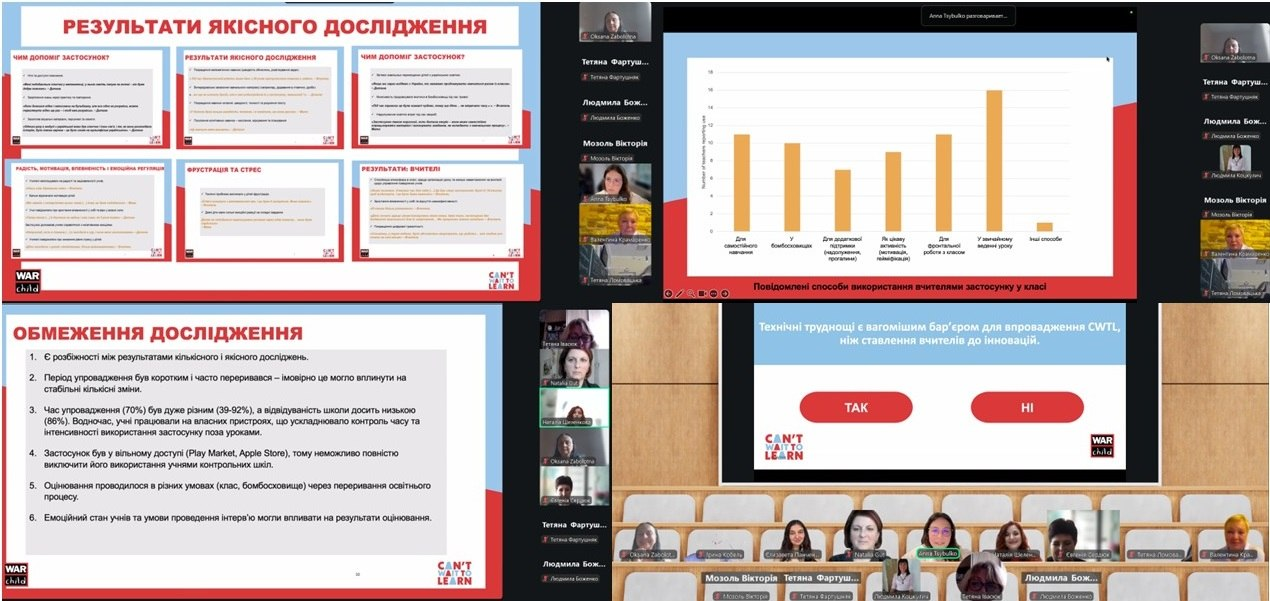
On 4 June 2026, a professional training entitled "Communicating Research Findings Effectively: Sharing the Results of the Can’t Wait to Learn Programme Evaluation" brought together members of the research team and trainers from the State Service for Education Quality of Ukraine.
The training was delivered by Yelyzaveta Panchenko, PhD in Pedagogical Sciences; Nataliia Shelenkova, PhD in Psychology, Associate Professor in the Department of Psychology at Uman National University; Anna Tsybulko, speech and language therapist and Lecturer in the Department of Social and Inclusive Education at Uman National University; and Natalia Hut, PhD in Philology, Associate Professor in the Department of Foreign Languages and Intercultural Communication at Uman National University.
The programme focused on strengthening participants' capacity to communicate findings from the evaluation of the Can’t Wait to Learn (CWTL) programme, implemented in Ukraine by War Child Alliance. Discussions covered the key stages of the research process, ethical considerations in research dissemination, confidentiality and data protection, and the importance of presenting findings accurately and responsibly without overstating the evidence. Participants also reviewed key results related to children's mathematical achievement, reading literacy, well-being, and other learning outcomes.
Through practical examples, the facilitators illustrated the differences between quantitative and qualitative research methods, introduced the principles of mixed-methods research, and demonstrated how multiple sources of evidence are integrated to produce robust research findings.
The interactive component of the training included the "CWTL Coding Laboratory", where participants analysed interview excerpts, identified emerging themes, developed qualitative codes, and collaboratively generated higher-level analytical conclusions. This hands-on exercise provided participants with practical experience in qualitative data analysis and demonstrated how individual narratives are systematically translated into evidence-based research findings.
The training also provided a platform for professional exchange and reflection on effective approaches to communicating research evidence to diverse audiences. The participants gained practical tools for preparing presentations, public briefings, and communication materials that support the dissemination and uptake of evidence-informed practices in education.