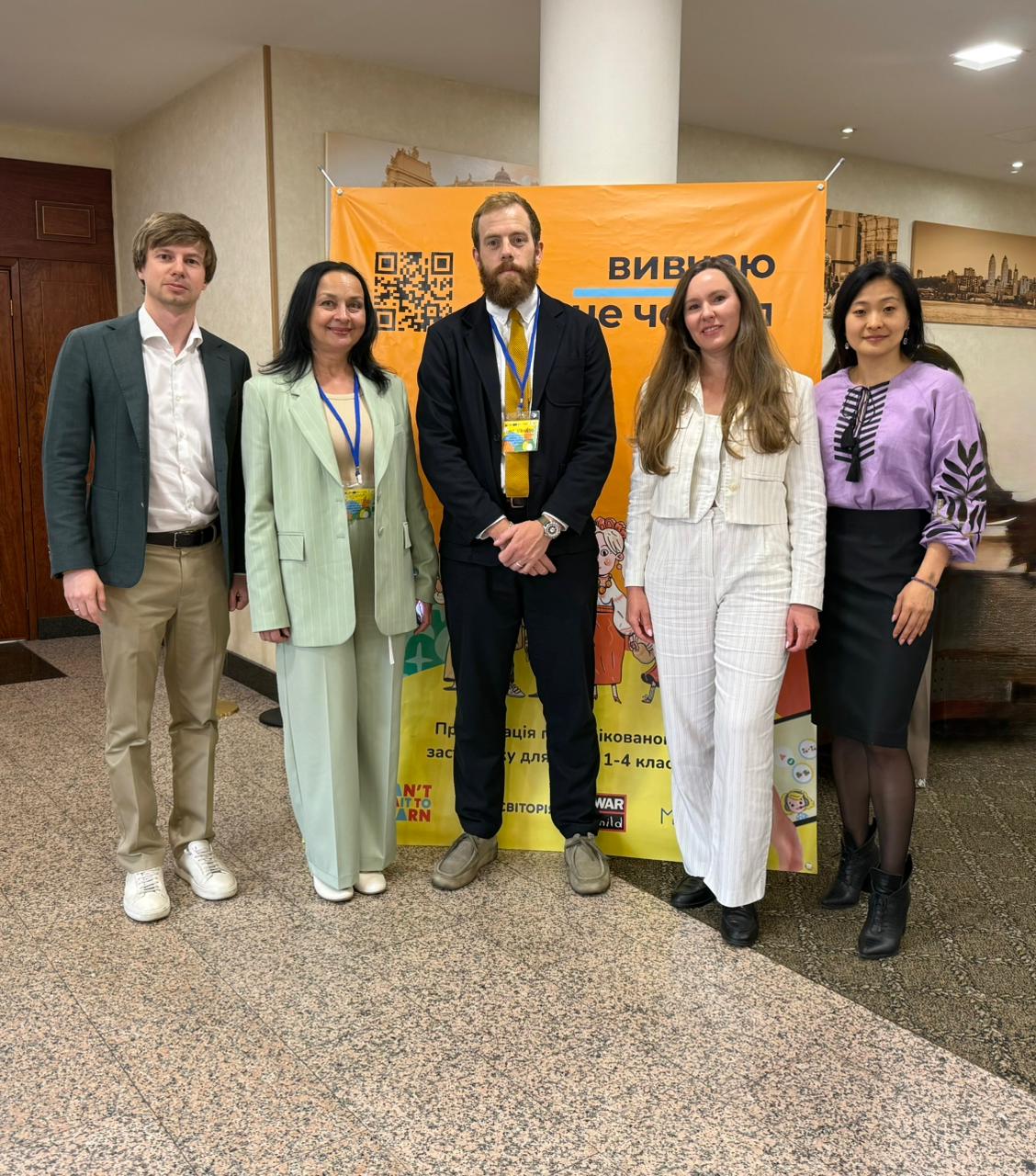
On 14 May 2026, the findings of the Ukrainian study of the “Can’t Wait to Learn” programme were presented at the conference “Can’t Wait to Learn: Results, Sustainability and Transfer to the State” in Kyiv.
The event brought together representatives of the Ministry of Education and Science of Ukraine (Dmytro Zavhorodnii), the State Service of Education Quality of Ukraine (Ivan Yuriichuk), Osvitoria Union (Anna Sydoruk), International Step by Step Foundation (Natalia Sofiy), trainers, and the programme team.
Opening remarks were delivered by Dmytro Zavhorodnii, Deputy Minister of Education and Science of Ukraine for Digital Development, Digital Transformation and Digitalization, and Ivan Yuriichuk, Deputy Head of the State Service of Education Quality of Ukraine for Digital Development, Digital Transformation and Digitalization. In their remarks, they highlighted the important role that the Can’t Wait to Learn programme has played, and continues to play, in addressing educational losses among Ukrainian children in the context of the ongoing war. They also expressed their gratitude to War Child Alliance for its continued support of Ukrainian education and for investing in innovative approaches that help children continue learning despite unprecedented challenges.
Anna Sydoruk, Chief Executive Officer at Osvitoria Union, and Luke Stannard, Can’t Wait to Learn (CWTL) Programme Director at War Child Alliance, presented the programme and reflected on its implementation journey in Ukraine. Their presentation was both powerful and emotional, illustrating how the programme evolved to becoming a widely recognised educational tool. They highlighted the role Ukrainian children played in localising the application. Through their feedback, ideas, testing, and participation, children helped shape a learning experience that is engaging, relevant, and enjoyable for Ukrainian learners.
Oksana Zabolotna and Yelyzaveta Panchenko presented findings from the UA-CWTL Quasi-Experimental Evaluation, which examined the association between participation in the Can’t Wait to Learn programme and students’ literacy, numeracy, and psychosocial wellbeing during wartime in Ukraine. The study combined quantitative data with stakeholder perspectives gathered from Grade 3 students, teachers, parents, school leaders, and education authorities.
The findings demonstrated that participation in the programme was associated with larger robust and significant improvements in overall numeracy performance and timed multiplication, compared to standard education. Additional positive effects were observed in areas such as missing numbers and word problems, although these results were less consistent. Qualitative evidence showed learners perceived gains in mathematics, computational fluency, and problem-solving skills. Many children reported mastering concepts such as column addition and fractions before encountering them in school. Teachers and caregivers confirmed these improvements, noting faster calculation, greater independence, and stronger academic performance.
In literacy, the programme was associated with encouraging but less consistent improvements in phonemic awareness, listening comprehension, and overall literacy performance, compared to standard education. While these effects were not consistently significant across all analyses, qualitative findings painted a positive picture. Students reported improvements in reading speed, accuracy, and comprehension, supported by audio features and engaging stories. Teachers and caregivers similarly observed stronger reading fluency and deeper understanding of texts.
The evaluation found no measurable quantitative changes in psychosocial wellbeing or sense of hope, with outcomes remaining stable and statistically comparable between intervention and comparison groups over time. However, qualitative findings suggested meaningful benefits of Can’t Wait to Learn. Children described increased confidence, resilience, and enjoyment of learning, while teachers observed greater classroom engagement and reduced stress. Caregivers also reported high levels of motivation among children to engage with the programme.
Across stakeholder groups, qualitative findings highlighted the value of gamification, personalised learning pathways, and flexible access to educational content in supporting learning continuity and reducing educational losses during war and displacement. At the same time, the evaluation acknowledged implementation challenges, including technical issues, varying levels of learner engagement, and constraints associated with conducting educational interventions in a wartime environment.
The event provided an important platform for dialogue among key stakeholders from the education sector. Participants discussed lessons learned, future opportunities for scaling evidence-based digital learning solutions, and upcoming knowledge mobilisation activities aimed at ensuring that research findings continue to inform educational policy and practice in Ukraine.